A Journey of Resilience, Discipline, Education, and Athletic Excellence
Before I pursued my dream career in the fire service, my original dream was to represent our country as an Olympic hopeful in Greco-Roman wrestling. For the majority of my childhood and early adult life, I dedicated myself to preparing for the opportunity to become a member of Team USA Wrestling. However, the foundation of that journey began long before I ever stepped onto a wrestling mat. It began with childhood adversity, personal loss, recovery, education, and the lessons instilled in me through martial arts.
The Early Years: Adversity, Loss, and Resilience
I was born in Inglewood, California, into a life that would quickly be shaped by change and loss. My parents were married for just 18 months before divorcing, and much of my early childhood was spent in the backseat of a car, traveling up and down California between homes for shared custody. Stability was something I didn't know yet—I only knew movement.
After the divorce, my mother moved us to Red Bluff, California. Life settled somewhat geographically, but emotionally, it remained complicated.
Then, at just six years old, my world shifted in a way that would change my life forever. On January 16, 1985, my father passed away from a heart attack at only 28 years old, following a history of coronary artery disease. Losing a parent is life-altering at any age, but as a child, it leaves questions and absences that echo for years.
Just 19 months later, another life-changing event occurred.
On August 19, 1986, while crossing the street in a crosswalk on my way to judo and jujitsu practice in Corning, California, I was struck by a vehicle. I was seven years old. I sustained multiple injuries to my face and head and lost consciousness following the collision. I was initially transported to Corning Hospital before being airlifted to Enloe Hospital in Chico, California, for further evaluation and neurosurgical care.
I don't remember the accident itself—a blank space where trauma lives—but its impact shaped everything that followed.
In the months after the accident, I had to relearn how to speak, read, and communicate. With the help of dedicated teachers, therapists, and educators at Olive View Middle School in Corning, California, I slowly rebuilt skills that most children develop without a second thought. What had once come naturally now required effort, patience, and persistence.
Looking back, my childhood was not defined by ease or stability, but by resilience. These experiences—loss, disruption, and recovery—formed the foundation of who I am today. They taught me how to endure, how to adapt, and how to keep moving forward, even when the path is uncertain.


The Beginning: Martial Arts and Mastering the Craft
At the early age of six, I was enrolled in my local martial arts academy, the Corning Judo & Jujitsu Academy, where I studied the martial sciences and became a member of the American Judo & Jujitsu Federation, Inc.
My sensei, Nick Labarthe, instilled in me the importance of hard work and discipline from a very early age. I developed a deep respect for the martial sciences and the concept of mastering the craft.
I received instruction in both English and Japanese. Before being awarded a promotion to each belt, I was required to know the pronunciation and spelling of every technique in both languages. This required preparation, repetition, dedication, and an understanding that advancement was earned through demonstrated knowledge and proficiency.
Those early lessons became the foundation of my personal philosophy. Mastering any craft requires more than simply showing up. It requires preparation, discipline, attention to detail, and a willingness to learn.
I continued participating in athletics throughout middle school and high school. During middle school, I discovered the correlation between the martial sciences and the sport of folkstyle wrestling. The discipline and fundamentals I had learned in judo and jujitsu translated naturally to the wrestling mat.
My athletic journey continued to develop, and I received the opportunity to travel with the Junior National Team from California to Atlanta, Georgia, two weeks before the opening ceremonies of the 1996 Summer Olympic Games.
Our California team included several athletes who would go on to become some of the most accomplished competitors in the sport of wrestling. Several of my teammates would later become NCAA National Champions, Olympic medalists, and Ultimate Fighting Championship competitors.
My teammates included Stephen Abas, Kyle Bunch, Danny Felix, Matt Evans, Steve Strange, Steve Schenk, Mark Munoz, Clint Wattenburg, Nick Kindred, and Billy Blunt.
Being surrounded by athletes of that caliber provided an early understanding of what it takes to compete at the highest levels of sport. I was learning that success was not accidental. It was the result of years of preparation, sacrifice, and commitment.


The Olympic Dream: Competing Against the Best
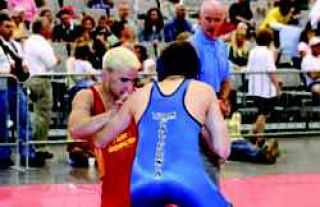
My first professional Greco-Roman wrestling match as an Olympic hopeful was in 1999 at the USA Wrestling National Championships in Las Vegas, Nevada.
As fate would have it, I drew the number-one-seeded Greco-Roman wrestler in the country, Shawn Sheldon, who was also among the top wrestlers in my weight class in the world.
Participating in the US Nationals in Las Vegas for several years, I consistently drew the number-one or number-two wrestler in my weight class from 2001 through 2003.
In 2003, I moved up a weight class and drew the number-two wrestler in the 60-kilogram weight class, Glenn Nieradka. At the time, Glenn was a five-time US Military Champion and an Olympic alternate.
Glenn was a USA Wrestling National Champion in 1999 and 2002, was named to the National Team for eight consecutive years, served as an Olympic alternate in 2000, and won nine Armed Forces titles.
To be the best at any competitive sport, you must compete with the best athletes in the world.
That philosophy became part of my approach to wrestling and, eventually, my approach to professional development in the fire service. You cannot expect to improve your abilities without challenging yourself, seeking out experienced mentors, and competing against individuals who push you beyond your comfort zone.
I also had the opportunity to compete in the West Regional Olympic Team Trials Qualifier. One of my memorable experiences from that tournament was meeting Urijah Faber before he became famous as "The California Kid" in the Ultimate Fighting Championship.
I remember talking with him before the tournament and joking, "It's a small world, Urijah, when two Cali Kids are wrestling at the same tournament in Battle Ground, Washington."
It's funny to look back on those moments and recognize the people you encounter along the way before they become household names.


The Academic Athlete: Balancing Education, Wrestling, and Work
As an Olympic hopeful, I traveled throughout the country and internationally, practicing and mastering the craft of Greco-Roman wrestling.
Countless hours were spent training while attending college. I was fortunate to participate in NCAA Division III athletics while pursuing my academic education.
My college years were built around a demanding schedule. Early morning workouts before class and afternoon wrestling sessions after class became part of my daily routine.
I also worked full-time after wrestling practice at Costco Wholesale in its Corporate Buying Office in Issaquah, Washington, to pay for my college expenses.
Balancing academics, athletics, and full-time employment required discipline and effective time management. There were no shortcuts. Every day required a commitment to balancing competing responsibilities while remaining focused on my long-term goals.
Graduating from high school in June 1995 at just 16 years old, I achieved a 3.776 GPA. Finishing high school ahead of the traditional timeline required focus, discipline, and a willingness to challenge myself beyond expectations.
My academic achievements were just as important to me as my athletic accomplishments. Education provided opportunities that extended beyond the wrestling mat, and I understood that developing intellectually was just as important as developing physically.
If you want to know the dedication it takes to achieve greatness, you must apply yourself in every aspect of your life.
During those early years, I learned the importance of time management, preparation, accountability, and maintaining a strong work ethic. These lessons would eventually become essential throughout my fire service career.


Team Washington and National Championships
I was blessed with the opportunity to continue wrestling beyond college with Team Washington State from 2002 through 2004 under USA Wrestling Gold Level Coach Larry Gibson.
Coach Gibson was inducted into the Washington State Chapter of the National Wrestling Hall of Fame in 1995 and received the Medal of Courage Award in 2009.
I was also fortunate to achieve two state championship titles as a competitor for the Greater Gold Wrestling Club under the guidance of 2000 Olympic Champion and Head Coach Brandon Slay.
One of the highest accomplishments of my Greco-Roman wrestling career came at the 2003 Amateur Athletic Union of the United States, Inc. (AAU) Grand National Championships at the Hampton Coliseum in Virginia, where I finished as the 2003 AAU National Runner-up in Greco-Roman wrestling.
For more than 16 years, I lived, breathed, and was consumed by the sport of wrestling. Wrestling was my entire life. It shaped my daily routine, my friendships, my personal expectations, and my understanding of what it meant to pursue excellence.
On June 1, 2004, after competing in the AAU Ironman World Championships in Bloomsburg, Pennsylvania, I retired from wrestling and my professional career as an academic athlete.
Although I was stepping away from competitive wrestling, the lessons I had learned over those 16 years would remain with me for the rest of my life.


From the Wrestling Mat to the Fire Service
When I began my fire service career, I discovered the correlation between my journey in the martial arts, my athletic wrestling background, and the profession of firefighting.
The same work ethic instilled in me by my sensei at the Corning Judo & Jujitsu Academy was equally applicable to public safety. The same concept of mastering the craft that I had pursued in Greco-Roman wrestling was also relevant to becoming a competent firefighter.
As a professional athlete, I understood the importance of practice, hard work, preparation, and dedication. I knew that developing proficiency required repetition, constructive criticism, accountability, and a willingness to learn from individuals with greater experience.
Those principles translated directly into the fire service.
Firefighting is a profession that requires continuous learning and professional development. The responsibilities associated with emergency response demand technical knowledge, physical conditioning, sound judgment, effective communication, and the ability to work as part of a team.
Just as in wrestling, there is always something to improve, another skill to master, and another opportunity to become better at your craft.
My background as an academic athlete provided a foundation for understanding that professional development is a lifelong commitment. Being physically capable is important, but understanding the science, strategies, tactics, and decision-making processes behind the work is equally important.
I began to recognize that the qualities developed through academics and athletics were not separate from my fire service career. They were complementary.
The discipline required to succeed in the classroom, the perseverance necessary to recover from childhood adversity, and the commitment required to compete against the best wrestlers in the country all contributed to the professional mindset I brought into the fire service.

The Tactical Academic Athlete
Looking back, I realize that becoming a tactical academic athlete was never simply about wrestling or academic achievement. It was about developing a mindset that could be applied to every aspect of my life.
My childhood experiences taught me resilience.
My sensei taught me discipline and respect for the craft.
My academic journey taught me preparation, accountability, and the importance of education.
My wrestling career taught me perseverance, humility, teamwork, and the importance of competing against the best.
My fire service career provided an opportunity to bring all those lessons together in service to others.
I spent almost my entire childhood and early adult life preparing for an Olympic opportunity that ultimately did not become my lifelong profession. However, I do not consider those years a loss or a detour. They were an important part of the person I would become.
Sometimes the journey we envision for ourselves is not the journey we ultimately take. That does not mean the time, effort, sacrifice, or lessons learned along the way were wasted.
The discipline developed in one profession can become the foundation for success in another. The mentors who invest in us, the challenges we overcome, and the standards we establish for ourselves continue to shape our future.
I may not have represented Team USA at the Olympic Games, but the pursuit of that dream prepared me for a different calling.
Today, I carry those same principles into the fire service: continue learning, remain physically and mentally prepared, respect the craft, seek mentorship, and never become complacent with what you already know.
Mastering your craft is not a destination. It is a lifelong commitment to becoming better than you were yesterday.
Corning Daily Observer
Red Bluff Daily News
Chico Enterprise Record
Snoqualmie Valley Record
Team Baker


2004 Olympic Trials


Amateur Athletic Union (AAU) Wrestling
2003-2004


Eastside Catholic High School
Academic State Champions 2004 Season

Coaches


Team USA Wrestling


Wrestling History


Image Credits: Author